What is coaching really for?
Updated: Jul 28
(And what should still be true years later)
We often talk about coaching as if it’s an event. A programme. A set of sessions that happen over a defined period of time and then… end.
And if we’re honest, sometimes the way coaching is talked about can make it sound a bit like a magic fix. Do coaching. Become better. Everything improves.
Most people who’ve actually been through coaching – or delivered it – know it’s rarely that simple.
The real purpose of coaching isn’t what happens in the room. It’s what still shows up long after the conversations have finished. It’s how someone thinks when the pressure is on, how they make decisions when there isn’t a clear answer, and how they lead when things feel uncertain, messy or complex.
At its best, coaching isn’t about giving people answers. It’s about creating the conditions for good quality thinking. A psychologically safe space where someone can pause, reflect, challenge their own assumptions and work out what they actually think – not just what they think they should think.
From that place, real development happens. Not just new ideas, but new habits. Not just insight, but confidence in judgement. This is why coaching can improve very tangible outcomes like performance, productivity and effectiveness, while also strengthening confidence, relationships and decision-making capability.
The Sticky Change view of coaching
For Sticky Change, coaching has always been about helping change stick. That means moving beyond insight and into behaviour – and then helping that behaviour hold when pressure increases.
And just to say this out loud: coaching is not about having a cosy chat and hoping something useful happens.
It is purposeful. Structured. Sometimes uncomfortable. Often energising. Usually very human.
In practice, that usually means:
Building trust and openness from the start
Being clear about what success looks like
Using challenge and support in equal measure
Creating space for real thinking rather than quick answers
Reviewing progress honestly
Turning learning into habits that hold under pressure

Because insight without behaviour change rarely lasts.
And behaviour change without support rarely sticks.
So how do you know if coaching has worked?
Most development is measured immediately afterwards. People are asked how they felt, what they learned and whether they would recommend the coaching.
All useful.
But also… a bit like judging a gym programme based on how you felt walking out of the first session.
The more meaningful question is usually:
What is still true years later?
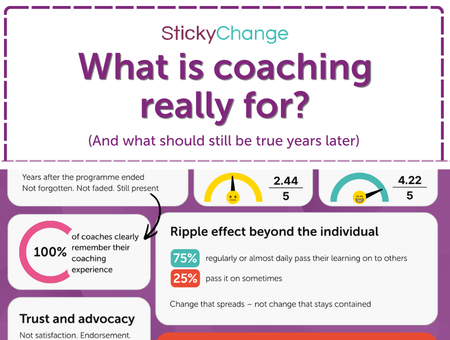
That’s why we looked at the long-term impact of coaching delivered between 2022 and 2025. Instead of focusing on immediate feedback, we looked at what people still carry with them into their day-to-day work.
What emerged was less about motivation or inspiration, and much more about capability – confidence in judgement, clarity in decision-making and habits that show up consistently in real working environments.
We’ve summarised the evidence in the coaching impact summary below.


Sustainable change is human, not just technical
Tools matter. Models help. Frameworks give structure. But sustainable change rarely comes from tools alone.
(If it did, most organisations would have solved change by now.)
It usually happens when people feel:
Safe enough to think clearly
Challenged enough to grow
Trusted enough to use their judgement
Supported enough to build new habits
When those conditions exist, change doesn’t fade when programmes end. It becomes part of how people lead, decide, relate and work.
The organisations that create the most sustainable change tend not to treat coaching as a quick fix. Instead, they use it to build internal capability over time – supporting people through real challenges and helping leaders develop ways of thinking that last far beyond a single programme.
Because when thinking changes, behaviour follows.
And when behaviour changes, culture shifts.
If you’re curious about whether coaching is the right support for your people or your organisation, we’re always happy to have a conversation.


Comments